Why Your Church or Organisation’s Website Isn’t Working in 2025 (And How to Fix It)
May 8, 2025 2212 words, ~12 min readTable of Contents
Key Takeaways
| Challenge | Solution |
|---|---|
| AI Search Visibility | Optimize content for question-answer format and clear information |
| Traditional SEO Decline | Adapt existing content for AI tools while maintaining SEO basics |
| Information Consistency | Regular updates across all platforms and clear contact details |
| Local Discovery | Use specific geographic references and community connections |
| Trust & Authority | Clear credentials, testimonials, and consistent messaging |
For Christian professionals and organisations, there’s a massive shift happening in how people search on the internet. More specifically, we should examine what tools people use to search the internet for them. Furthermore, this shift could potentially change how the internet works forever, and unfortunately, there does not seem to be any way to stop it due to how companies are using AI.
Large Language Models, or LLMs for short, like ChatGPT or Grok, began using the internet for their answers and reasoning. Simultaneously, this development proved quite useful, as your answers were more accurate and up to date. However, it presented a more specific problem—the general public began to talk to these LLMs more than actually search the web.
Moreover, it’s perfectly understandable. This is a very convenient way to get information from the web without having to search for it yourself. Nevertheless, the catch is that when someone is searching for a product, service, business or church, they may be inclined to use the same method rather than surf the web.
The Growing Trend of AI-First Search
In fact, there is a growing trend of the adoption of this behaviour, which puts your ministry or organisation at risk of being invisible online. Despite potentially having a well-built and SEO optimised website and effective ad campaigns, you may still struggle with visibility. Consequently, this trend has given rise to the term “GEO”—Generative Engine Optimisation.
This represents a major shift from people finding your website online through a few minutes of searching with the help of SEO, to ranking in AI search results. As a result, traditional SEO tactics like articles, relevant keywords found in your site and other methods won’t have as much value as they used to in the past.
How AI Search Affects Church Websites
Before we look at solutions, let’s understand what this actually means for your church or organisation. When someone asks ChatGPT “What are good churches near me?” or “Where can I find Christian counseling services in my area?”, the AI doesn’t necessarily send them to your website. Instead, it gives them a summary answer based on what it found across the internet.
Consequently, your carefully crafted website content gets filtered through AI, and you lose the direct connection with people who need your services. This means fewer people are clicking through to your website. Additionally, fewer people are reading your full story, your mission statement, or your service details. Most importantly, fewer people are taking the next step to contact you or visit your church.
The Impact on Ministry Websites
The numbers tell the story: Churches that haven’t adapted to AI search are seeing up to 40% fewer website visits from search-related traffic. Meanwhile, ministries that have optimized for AI tools report more qualified visitors who already understand what they offer.
Why Traditional SEO Is Losing Ground
The old way of getting found online relied on people typing searches into Google and clicking through to your website. Previously, you optimized your content for specific keywords, created blog posts, and built backlinks. These strategies worked because people would scan through search results and choose which websites to visit.
Now, however, AI tools are doing that scanning for them. When someone asks an AI about local churches, it reads through dozens of websites and gives one combined answer. Although your website might be included in that research, the person never actually visits your site.
Adapting Your SEO Strategy
This doesn’t mean your SEO efforts were wasted. Rather, it means you need to adapt your approach to work with AI tools, not against them.
The Good News: You Can Adapt
Here’s the encouraging part—you don’t need to start from scratch. Many of the things that made your website good for traditional SEO also help with AI search results. Furthermore, the key is understanding how to present your information in a way that AI tools can easily understand and share.
Think of it this way: instead of optimizing for Google’s algorithm, you’re now optimizing for AI that reads and summarizes web content. Consequently, this actually opens up new opportunities to connect with people who are looking for exactly what your ministry offers.
What Generative Engine Optimisation Means for You
GEO is about making your online presence work well with AI tools. When someone asks ChatGPT or similar tools about churches, Christian services, or ministry resources in your area, you want your organization to be mentioned in the response.
This requires a different approach to how you structure your content. AI tools look for clear, factual information that directly answers common questions. Moreover, they prefer content that’s well-organized, specific, and easy to understand.
What AI Tools Look For
For example, if you’re a church, AI tools want to know your service times, location, denomination, and what makes you unique. Similarly, if you’re a Christian counselor, they want to know your specialties, approach, and contact information. The clearer and more direct you make this information, the more likely AI will include you in its responses.
Quick Wins for Ministry Websites
Make Your Basic Information Crystal Clear
Start with the fundamentals. Your website should clearly state who you are, what you do, where you’re located, and how people can contact you. Furthermore, don’t hide this information in paragraph text—use headers, bullet points, and clear sections.
For churches, this means having a dedicated page or section that covers:
- Service times and locations
- Denomination or church background
- Age groups you serve
- Special programs or ministries
- Contact information and directions
- Parking and accessibility details
For Christian businesses or ministries, focus on:
- Services you provide
- Who you serve
- Your approach or philosophy
- Credentials and experience
- How to get started
- Pricing or consultation process
Create FAQ-Style Content
AI tools love content that directly answers common questions. Think about what people typically ask about your ministry, then create content that addresses these questions head-on.
Instead of writing long blog posts about your church’s history, create sections that answer questions like “What should I expect at my first visit?” or “Do you have programs for young families?” These direct, helpful answers are exactly what AI tools look for when responding to user questions.
Common Questions About Church GEO
What makes a church website effective in 2025?
A church website needs clear structure, consistent information across all platforms, and content that directly answers visitor questions. Additionally, focus on practical details like service times, childcare availability, and what to expect during visits.
How do I know if my church appears in AI search results?
Test this by asking AI tools like ChatGPT about churches in your area. Check if your church gets mentioned and what information appears. If you’re not showing up, it’s time to improve your online presence.
What’s the difference between SEO and GEO for ministries?
SEO focuses on getting people to click through to your website. In contrast, GEO focuses on getting AI tools to mention your church when people ask questions. Both are important, but GEO is becoming more critical for visibility.
How much does church website optimization cost?
Many improvements can be made for free by updating existing content. However, professional optimization services are available to enhance your online presence.
Use Local and Specific Language
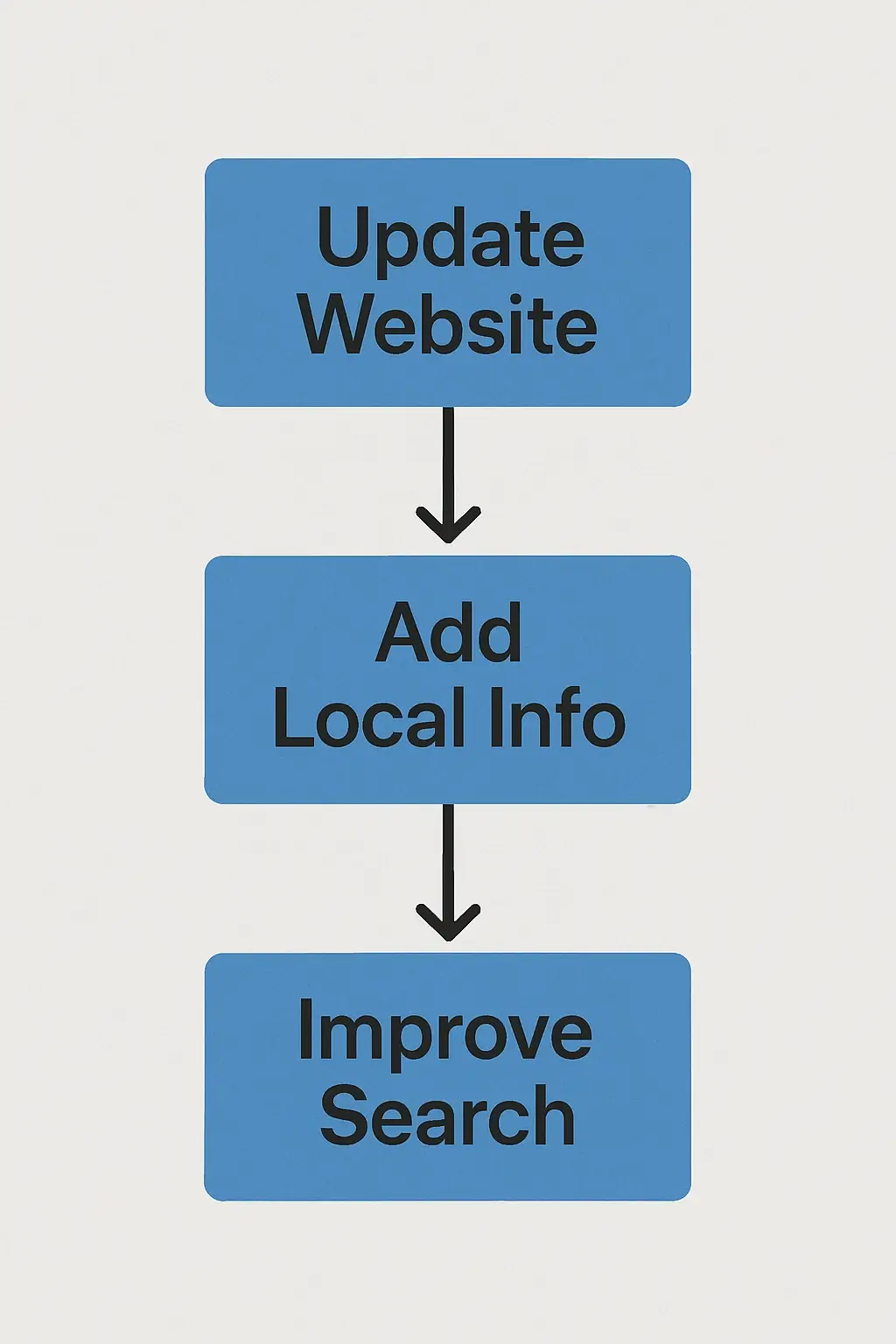
AI tools are particularly good at understanding location-based searches. Therefore, make sure your content includes specific geographic references, not just your address. Additionally, mention the neighborhoods you serve, nearby landmarks, or local community connections.
If you’re a counseling service in downtown Springfield, don’t just say “Springfield area.” Instead, mention specific neighborhoods, nearby schools, or local partnerships. This helps AI tools understand exactly where and how you serve your community.
Examples of Effective Local Language
- “Serving families in the Westside neighborhood since 2010”
- “Located two blocks from Springfield Elementary School”
- “Partnering with local food banks and community centers”
- “Easy access from Highway 9 and Main Street intersection”
Keep Information Current and Consistent
AI tools pull information from multiple sources about your organization. If your service times are different on your website than on your Google listing, or if your phone number varies across platforms, AI tools may not know which information to trust.
Moreover, regular updates matter more than ever. If you change service times, add new programs, or update your contact information, make sure these changes appear consistently across all your online platforms.
Monthly Consistency Checklist
- Verify service times across all platforms
- Check contact information accuracy
- Update program descriptions
- Review staff listings and credentials
- Confirm location and directions
Building Trust with AI Tools
AI Pragmatic AI systems are designed to provide accurate, helpful information. Therefore, they tend to favor sources that demonstrate expertise, authority, and trustworthiness. For Christian organizations, this means being transparent about your beliefs, clear about your services, and consistent in your messaging.
Share testimonials and success stories, but make them specific and genuine. Instead of generic praise, include details about how your ministry actually helped someone. This kind of authentic content helps AI tools understand the real value you provide.
Trust Signals That Work
- Clear leadership and staff credentials
- Specific testimonials with real outcomes
- Transparent about beliefs and practices
- Regular content updates and engagement
- Community involvement and partnerships

Implementation Timeline for Churches
Phase 1: Foundation (Weeks 1-2)
Week 1-2: Foundation
- Audit current website information
- Update contact details across all platforms
- Create basic FAQ section
- Ensure service times are clearly displayed
Phase 2: Content Enhancement (Weeks 3-4)
Week 3-4: Content Enhancement
- Add detailed program descriptions
- Include staff credentials and backgrounds
- Create visitor information pages
- Add testimonials and community involvement
Phase 3: AI Optimization (Weeks 5-6)
Week 5-6: AI Optimization
- Structure content for question-answer format
- Add local geographic references
- Include specific service details
- Test AI search mentions
Phase 4: Monitoring and Adjustment (Weeks 7-8)
Week 7-8: Monitoring and Adjustment
- Track website traffic changes
- Monitor AI search mentions
- Gather feedback from new visitors
- Make refinements based on results
Tools and Resources for Ministry Leaders
Free Tools
- Google My Business for local listings
- ChatGPT for testing search mentions
- Google Analytics for traffic monitoring
- Schema markup generators for structured data
Budget-Friendly Options
- Canva for creating visual content
- Mailchimp for email integration
- WordPress plugins for SEO basics
- Social media scheduling tools
Professional Services
- SEO audit services
- Content writing for churches
- Website optimization
- Monthly monitoring services
The Future Is Collaborative, Not Competitive
The shift to AI-powered search doesn’t mean you’re competing against technology. Instead, you’re learning to work with it. Furthermore, AI tools want to connect people with helpful, relevant resources—exactly what your ministry provides.
The organizations that will thrive in this new environment are those that make it easy for AI to understand and share their value. This means clear communication, consistent information, and a focus on genuinely helping people find what they need.
Your Next Steps
Start by auditing your current online presence. Look at your website, social media profiles, and directory listings. Ask yourself: if an AI tool was trying to explain what your organization does and why someone should choose you, would it have clear, consistent information to work with?
Then, begin making small improvements. Update your contact information, clarify your service descriptions, and organize your content around common questions. These changes will help both traditional search engines and AI tools understand your ministry better.
Action Steps for This Week
- Test your church’s AI search visibility
- Update your Google My Business listing
- Create a simple FAQ section
- Check information consistency across platforms
- Plan your content optimization timeline
Remember, the goal isn’t to game the system—it’s to clearly communicate the valuable work you’re already doing. The same qualities that make your ministry effective in person—clarity, consistency, and genuine care for people—will help you succeed online as well.
The internet is changing, but your mission remains the same. By adapting how you present your ministry online, you can continue reaching the people who need your services, regardless of how they choose to search for them.
Looking for more specific guidance on optimizing your church website for AI search? Church Web Studio offers future-minded website development to help your ministry thrive online. The key is starting with small, consistent improvements that build trust and clarity over time. Focus on serving your community well online, just as you do in person.